
Forget all rigid software development processes. There is no universal model that fits everyone. Depending on the project's maturity level, risk profile, corporate culture, timeline, and available budget, UX, Business, and Development must adapt flexibly.
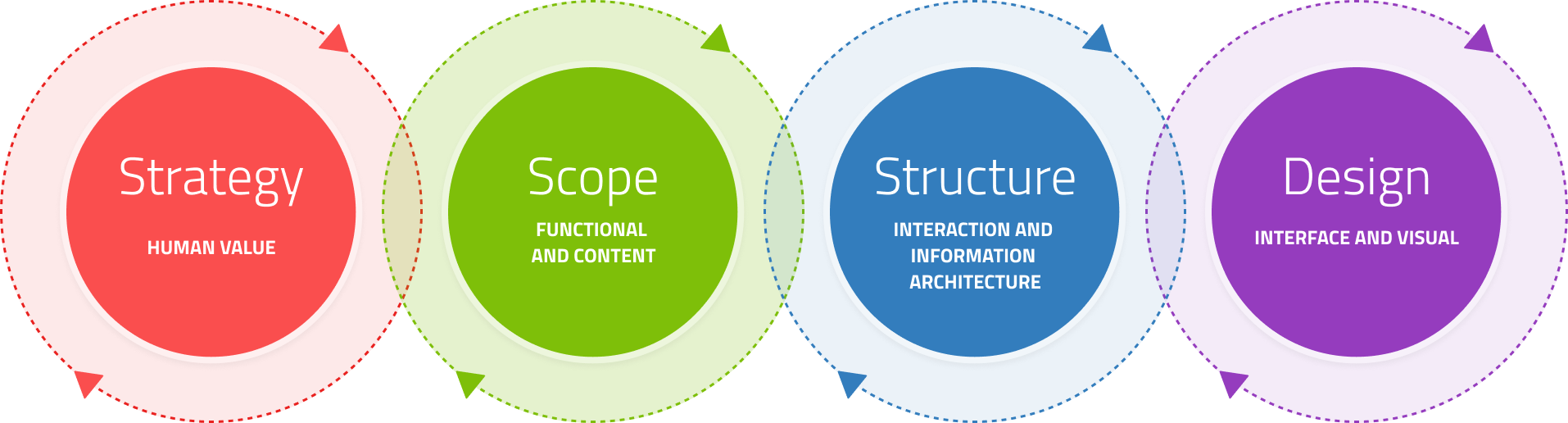
Our Services at a GlanceUser-Centered Design means that we involve real users right from the start.
Why?
Because, ultimately, these people decide the success of your product. When we understand their needs, the best results emerge: products that are easy to use, useful, and attractive.
This Is How People-Centered Design Works
We get to know the needs of your users and align them with your business requirements. From needs, we formulate requirements; from requirements, features emerge; and features become experiences.

Good UX is not merely a feeling; it can be objectively measured. It is important to us to conduct such measurements regularly.
Why?
An initial measurement prior to the project launch reveals which areas of the product hold the greatest potential for development. With each subsequent measurement, we monitor our progress and demonstrate that UX and satisfaction are indeed improving.
This Is How to Objectively Measure Satisfaction
Users are invited via email to participate in a 10-minute online survey. The standardized UEQ questionnaire ensures objectivity, reliability, and validity, and measures UX across six areas.
Attractiveness
Do the users like the product?
Stimulation
Is using the product exciting and motivating?
Originality
Is the product innovative and creative?
Efficiency
Can users complete their tasks without unnecessary effort?
Transparency
Is it easy to familiarize yourself with the product?
Controllability
Do users feel they have control over the interaction?

More efficient than meetings, more effective in their results, and significantly more enjoyable to conduct, they are particularly valuable during the early phases of a project—whether remote or in person. Our toolkit is fully stocked: it features proven standard formats, proprietary coeno modules, or an entirely new format perfectly tailored to your specific challenge.

It provides clarity regarding the truly critical challenges, while structuring and streamlining decision-making. Potential solutions are outlined and incorporated into an action plan.

Establish a shared understanding of the meaningful scope of an application and define concrete usage and system requirements—whether for an MVP or the next release.

A value proposition formulated based on the problems and expectations of users. It provides clear guidance ranging from the product vision to the specific implementation of features.

Joint resolution of medium-scale, complex challenges over two intensive days. Resulting in consolidated requirements, ideas, and implementation sketches for digital systems or products.

Design Thinking is not a workshop, but a mindset. Nevertheless, in the “rapid” variant, it is possible to complete all phases in a single day—thereby creating genuine innovations based on human needs.

The big sister of the UX PowerDays (spanning four days). Ideas are transformed into prototypes, validated directly with real users, and optimized based on the results. Can also be supplemented with additional iterations.

Provides an overview of the activities and tasks that users perform on the system to achieve their goals. The result is a workflow represented by sorted Post-it notes, along with a categorization of features into releases.


.svg)


